
Marble Court Docket Searches
Never assume Marble has a live municipal docket. Start with the paper itself. A state citation or a case number tied to a Colorado court class points to a state court. That means Gunnison County Court or Gunnison District Court. A local ordinance question may instead call for a Town record request. Ask the Town first whether any current judicial record exists at all. The ordinance archive cannot answer that on its own.
For a state case, the Colorado Judicial Branch calendar shows upcoming Gunnison settings. The clerk at Gunnison Combined Courts supplies the official ROA and filed documents. Is the issuing office unclear? Describe the issuer and case class to the Town or state clerk before sending any request.
- Read the issuing agency, payee, and court on the document.
- Ask the Town about a local ordinance or administrative record.
- Use the state docket search for a County or District Court hearing.
- Call Combined Courts for the official state file or a date conflict.
- Do not infer a Marble court, judge, or schedule from old ordinances.
Marble Municipal Court History
The Marble ordinance archive holds a 1982 enactment titled Municipal Court, along with traffic and parking measures. That is a genuine historical record. It shows Marble's lawmakers addressed municipal-court authority back then. It does not show that Marble holds court today, staffs a judge, or runs a citation portal.
Authorized and operating are two different things. A town can enact court authority by ordinance. It may yet hold no current session and publish no clerk channel. So the honest description of the Marble court situation is that no active municipal docket is confirmed. Ask the Town about current ordinance records, and take state judicial matters to Gunnison Combined Courts.
- Ordinance archive
- The Town's collection of enacted local measures, including historic material.
- Historical authority
- Evidence that a municipal court was addressed in law, not proof of present sessions.
- Current docket
- A live court schedule or case chronology, which was not verified for Marble.
Inside Marble Municipal Court
The Town publishes no current municipal court page, judge listing, hearing calendar, or payment system. That absence should be stated plainly. Inventing a judge would turn a gap into a false fact. So would guessing a court day. The Town stays the sensible contact for local ordinance records. It created those materials and keeps them.
Ask a narrow question: does Marble maintain a judicial file for the cited ordinance, or is the item purely administrative? If no town judicial proceeding exists, do not force the matter into a municipal court label. A Colorado citation, misdemeanor, traffic case, civil case, or felony follows the state court structure. Search those through Gunnison County.
Verified status: Marble is incorporated, but no active municipal court, current judge, public calendar, or citation portal is confirmed for the town.
Marble Ordinance Archive Records
The ordinance archive earns its keep when you want to understand Marble law, trace an old enactment, or pin down the title and year of a local measure. It is not a party-name case lookup. Note the ordinance title, adoption year, subject, and any later amendments. Then ask the Town whether related administrative records exist.
The distinction matters most for older material. A 1982 Municipal Court ordinance can explain the legal framework of that era. It cannot show who appeared, what ruling was entered, or whether a modern case exists. Those answers live in a court file, if one exists, or in a state case record from Gunnison Combined Courts. The archive is context, not proof of any outcome.
| Source | Can show | Cannot prove |
|---|---|---|
| Marble ordinance archive | Local law and historical enactments | A current hearing or case outcome |
| Town record response | Current local records held by Marble | A state court file |
| Combined Courts | Official County or District Court record | A separate town administrative file |
Finding Marble Court Dates
Marble posts no municipal calendar, so no current town date can be supplied. Does a document name Marble or a town ordinance? Call the Town and ask whether the matter has a hearing and which body will hear it. Trust the date printed on the notice until an official direction changes it. Never borrow a date from another town's schedule.
For a state case, run the Gunnison County docket search. Match the full case number. Then read the date, time, hearing type, appearance mode, and courtroom. If anything conflicts, the clerk at Gunnison Combined Courts can sort it out. Call 970-642-8300. A public virtual link is not permission to appear remotely.
| Date | Use the official notice or current state docket entry. |
|---|---|
| Time | Confirm with the custodian because no Marble calendar was verified. |
| Location | Follow the issuing authority, not an assumed town courtroom. |
| Case number | Match year, class, and sequence for a Colorado state case. |
| Setting type | Read the event label and ask the clerk what attendance requires. |
Marble Remote Court Record Steps
Marble sits deep in the mountains. Confirm before you drive. Contact the Town before any in-person visit and ask how Marble prefers a focused request. State judicial records can be requested through the Colorado Judicial Branch Record/Document Request Form. The Combined Courts clerk can coordinate by telephone. The state courthouse sits at 200 E. Virginia Avenue in Gunnison.
Give the case number if you have it. Otherwise offer an exact name, an approximate year, the issuer, and the record type. Request the ROA when a chronology answers the question. Request the specific order, ticket, or judgment when the entry alone is not enough. Broad requests create more search and copy work. A well-defined one avoids it.
Gunnison Combined Courts
200 E. Virginia Ave.
Gunnison, CO 81230
970-642-8300
State County and District Court settings, ROAs, filed documents, and certified records.
Marble Traffic Ticket Lookups
Not every traffic or parking paper from Marble points to a town courtroom. Read the issuer and the payee before you send anything. A Colorado state penalty assessment goes through Department of Revenue instructions. A state traffic summons filed in Gunnison County Court runs through Gunnison Combined Courts instead. If the paper cites only a Marble ordinance, ask the Town which process applies today. Skip any unverified municipal portal.
The payment route matters because paying counts like a plea. A payable state penalty assessment is one thing. A summons that requires an appearance is another. The town offers no Marble-specific citation payment tool. The Gunnison County traffic court record route walks through the state court and DOR channels. It does so without inventing a town procedure.
| Paper clue | Route |
|---|---|
| Colorado DOR penalty assessment | Follow the state penalty-assessment instructions |
| Gunnison County Court summons | Use Combined Courts |
| Marble ordinance reference | Ask the Town for the current local process |
Marble Court History Image
The official Marble ordinance archive holds the town's historic municipal-court material.
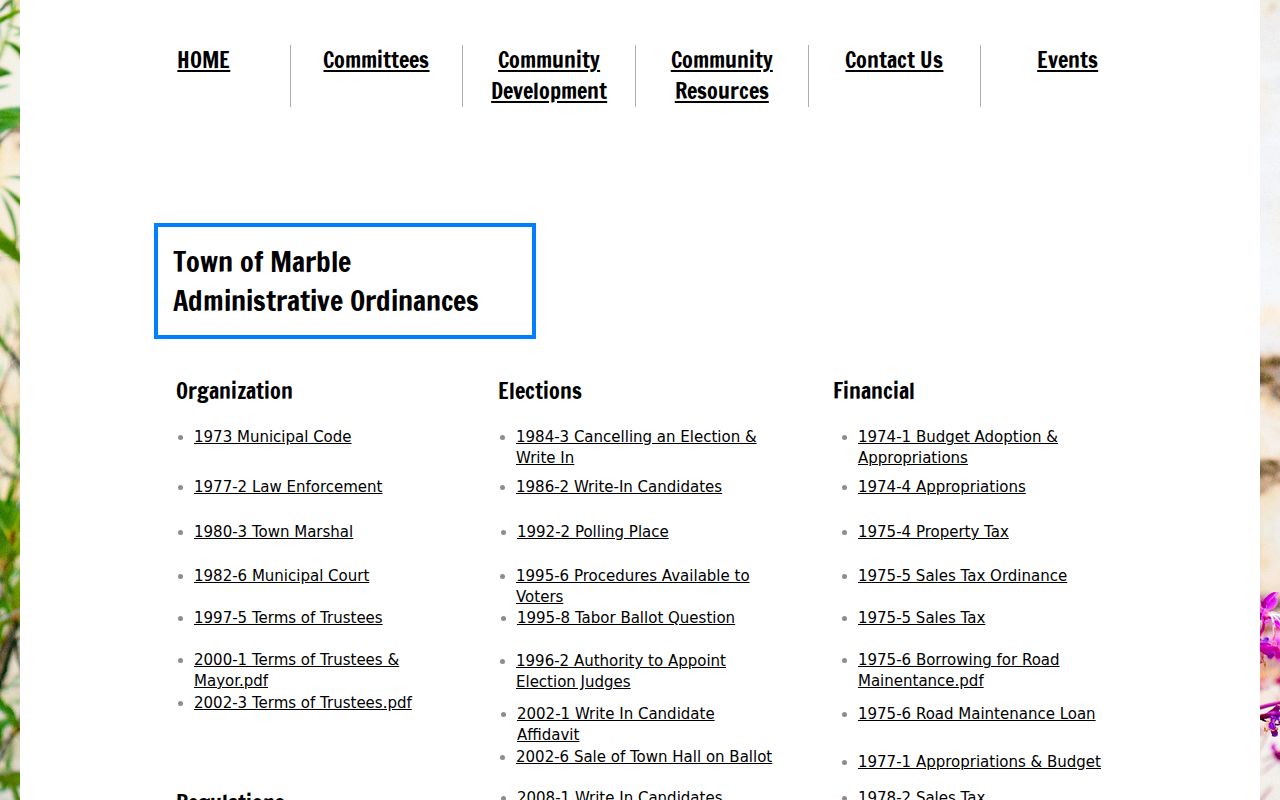
That archive preserves the historical ordinance itself. It is not a current Marble court docket, and it should never be presented as one.
How Marble Cases Reach the County
A Marble matter built on Colorado law lands in one of two state courts. Gunnison County Court handles misdemeanors, most state traffic cases, small claims, and limited civil matters. Gunnison County District Court takes felonies, major civil actions, domestic relations, probate, juvenile matters, and other district cases. The Clerk of Court at Gunnison Combined Courts keeps the files for both.
Docket flow: Marble local record check › Gunnison County Court › Gunnison County District Court
The record check comes first because no active Marble municipal court is established. That phrase is not proof of a judicial tier. Most state cases simply begin in the court that law assigns. The case class is printed as T, M, C, S, CV, or CR. It helps you pick the right state docket. Use it exactly as it appears.
Marble Case-Class Court Records
Colorado case numbers help when the town name tells you little. The year comes first, then a class, then a sequence. T usually marks County Court traffic. M is a County Court criminal matter. C is a county civil case, and S is small claims. CV means District Court civil. CR means District Court criminal. Those codes point to the state clerk, not to a Marble ordinance archive.
Type the year, class, and sequence into the state calendar fields. A number like 2025CV30018 splits into those three parts. A blank search is not the end of the story. Widen the date range and confirm Gunnison County. Then call the clerk. A missing future event does not mean no case or historic record exists.
Who Can See Marble Court Records
Marble town records sit under their own public-record rules. But a local administrative record and a state judicial file answer to different custodians. Ordinance material maintained by the Town stays with the Town. State dockets, documents, and certification come from Gunnison Combined Courts. Gunnison County's general CORA office does not hold the state court file. The elected Clerk and Recorder does not either.
State access under Chief Justice Directive 05-01 has limits. Sealed cases, juvenile matters, protected identifiers, and specified documents can be left out. A public calendar also shows less than a full ROA. An empty online result may trace to the date range, the wrong court, or restricted status. It may not mean the absence of any record.
Record boundaries:
Marble's archive supplies town ordinance history.
CJD 05-01 governs state judicial access.
The state form requests official ROAs and documents.
Marble Record Verification
A sound Marble inquiry states plainly what is known and what is not. List the issuer, the citation or case number, the date, and the ordinance or statute. Name the record you want. Ask the Town whether it holds a current local file. If the Town points you to state court, use the Combined Courts clerk. Avoid rebuilding a municipal process from the 1982 ordinance. That approach protects the useful historical record without overstating it. Marble is small. Its population of 133 in the 2020 Census proves nothing either way about a modern court. Only a current official source or custodian can settle that.
Keep the Town's response with the original paper. Suppose Marble confirms no current local judicial file. The response then explains why the state route was used. If Marble names a local custodian or a current proceeding, follow those official directions. Skip the third-party guess. The goal is a traceable Marble court record path built on current facts.
Marble Certified State Records
Is a Marble-related matter a state case? Gunnison Combined Courts can supply an official ROA or the document behind a docket entry. The state request form separates a ticket, a judgment, an order, and other papers. Use the case number and name the exact item. A vendor register may show the chronology. It does not deliver filed images or a certified Marble-related state record.
Certification currently costs $20 per document, on top of copying charges. A plain copy may serve for personal review. An agency or legal process may demand certification. Ask the recipient what it requires before you order. This saves you from paying for certification when a plain Marble case copy will do. It also keeps you from presenting an informal register result as an official court record.
The state form targets three business days absent extenuating circumstances. Older Marble-related files may carry actual-cost retrieval charges. A name-only search can cost more than a case-number request. A focused year, class, sequence, and document title gives the clerk a clean Marble record path to follow.
Marble Custody Decision Record
Treat Marble as a place name first, not a presumed court. The town itself can tell you whether it holds an ordinance file. An administrative item is not a docket. If the town names a current judicial custodian, follow its directions. A state case referred to Gunnison comes with an explanation of the change in route. That referral should stay attached to the source paper you keep.
Check the citation itself before requesting records. Confirm the law cited and the payee listed. When Marble shows up only as the event location, the real forum is likely Gunnison County Court. A Marble ordinance points back to the town. Ask Marble who the current custodian is. Archive material deserves a history label. Those papers describe what the town once kept rather than where its court operations sit today.